The brown bear (Ursus arctos) belongs to the bear family (Ursidae). Most importantly, it is the largest living predator currently on the European continent.
The brown bear has several subspecies that are larger (grizzly bear, Kodiak bear or Kamchatka bear). Generally, however, the brown bear grows to a weight of around 350 kg (sometimes even 650 kg depending on living conditions). Females are noticeably smaller, up to tens of percent in size and weight. An adult bear grows up to 130 cm at the shoulder and can measure up to 4 meters in length.
Its stocky robust body has a dense brown color in various shade variations.
It is undoubtedly the most dangerous predator in Europe.
Generally, the brown bear inhabits mountainous terrain with extensive forests, but we can also find it in lowlands towards the east. What is important for the bear is sufficient peace and quiet, extensive forest and forest-steppe landscapes.
The brown bear occurs throughout almost all of Eastern Europe, including North America and Northern Asia. These are always different subspecies. For example, the Eurasian bear lives in our country, but in America there is the grizzly bear or Kodiak.
It was exterminated in our territory and sporadically a visitor appears from Slovakia, where on the contrary it is very widespread and with great exaggeration it can be said that the bear is overpopulated in Slovakia.
Bears are solitary. Especially old males. Females, on the other hand, live together with their young. However, they gather together with males during the breeding season, which lasts from May to July.
Bears are very aggressive animals, especially within their own species, when old males can very often attack younger males. Their aggression is also clearly demonstrated by females defending their young. Such a female is capable of standing up even to a male bear.
Unfortunately, a human encounter with a bear in such a case can end fatally.
However, a bear’s territory can be quite extensive, from several dozen square kilometers to several hundred kilometers. Territories overlap considerably with other bears and they more or less tolerate this.
Female brown bears come into rut once every three to four years. Bears exhibit so-called latent or false pregnancy, which means that the fetus develops to a certain stage and then its development stops for several months. Once the appropriate time comes, the fetus’s development resumes and usually takes 8 to 10 weeks to complete. After that, several cubs weighing only about 500 grams are born to the female bear during the winter months.
Bears hibernate. This means that they settle in their dens for winter sleep, their metabolism slows down and they survive the winter this way. If it is a warm winter, premature awakening or interruption of hibernation may occur.
The bear is an omnivore and can consume almost everything from blueberries, earthworms, rodents, carrion to large mammals or fish.
Brown bear hunting usually takes place either in spring (May period – mating), or in autumn during September. This is due to increased bear activity.
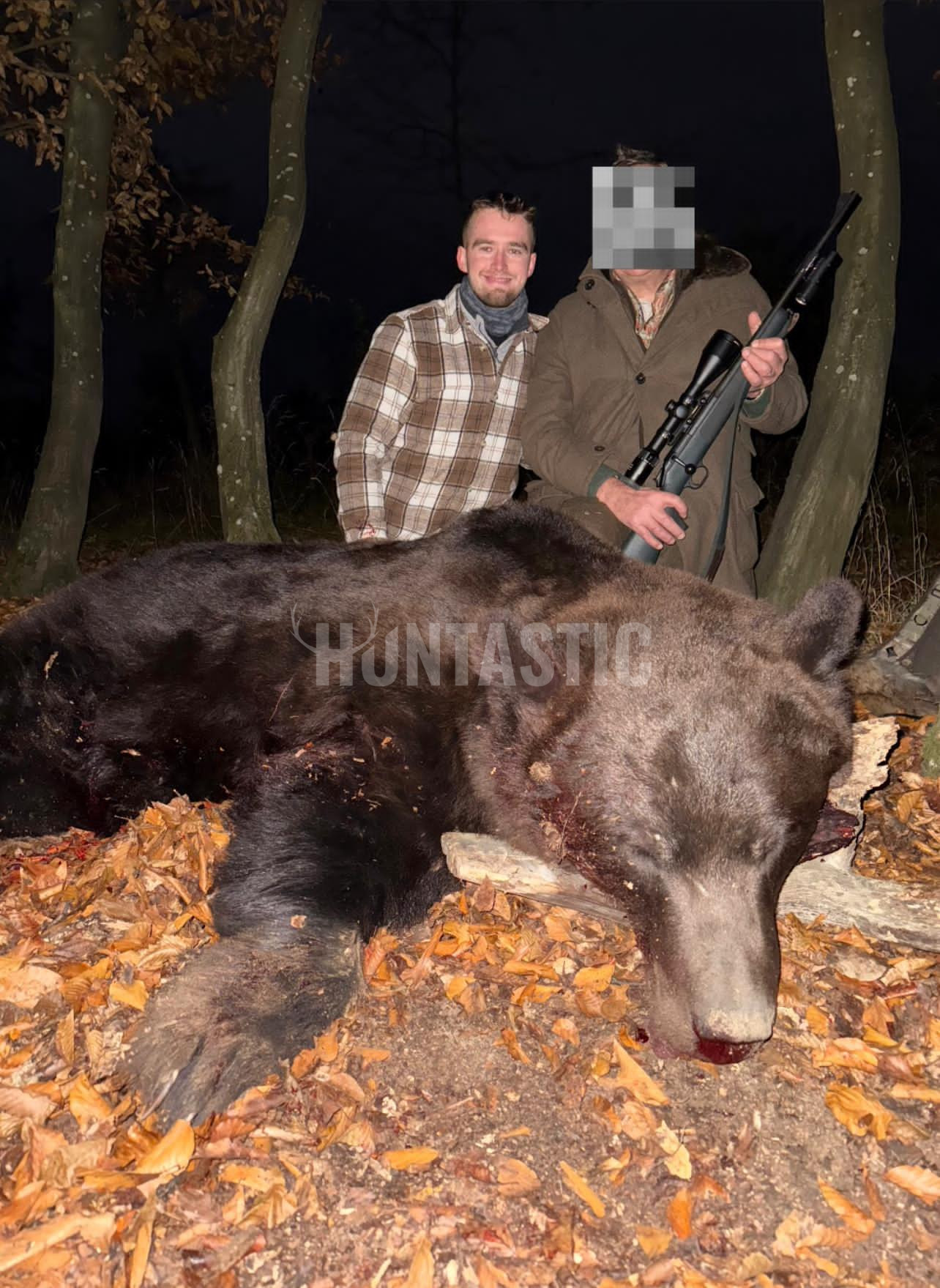
For example, in Romania, brown bears can be hunted at baiting sites where they come to feed. They are hunted by high seat hunting from high tree stands and their hunting is not particularly demanding. Hunting takes place at dawn and at dusk.
However, for example in Russia, bears are hunted in so-called den hunting. This method of hunting is very dangerous, but at the same time very valued for the skill of hunting guides, an unforgettable hunting experience and above all the long cultural history of hunters in Russia who experience and revere this method of hunting as a sacred ritual.
Den hunting of bears is done by tracking down an occupied den in winter where a bear is sleeping. Subsequently, hunters are positioned who have effective shotguns with single bullets and cover each other. Then the bear is driven out of the den and the hunters have a very short time to shoot. They hunt from several meters away.
For bear hunting, for example, a shotgun with a single bullet is suitable in the case of “den” hunting. In the case of high seat hunting, it is necessary to have a powerful rifle caliber, for example 7mm and above (.308 Win, 30-06 Spring. etc…). The ammo used is important, which must have sufficient energy of at least 2,700 J at 100 meters. Given that bears are hunted at baiting sites at relatively short distances, the energy is sufficient.
The bear trophy is a skull recognized by international method, which is scored by CIC points. An equally valued trophy is the bear’s hide, which occupies a place of honor in many a hunter’s hunting salon interior, or bear claws. Furthermore, hunters have the entire bear stuffed (if they have a place to put it).
Bear meat must first be examined for trichinosis. The meat is a valued and sought-after delicacy by locals and foreigners alike. Bear fat has a fine structure and is used not only for culinary purposes, but also for treating bronchitis by rubbing it on the chest (just like badger fat). It has anti-inflammatory effects.
In folk medicine, dried bear bile also has immense value.
We hope this article was useful to you!
Your Huntastic Team